
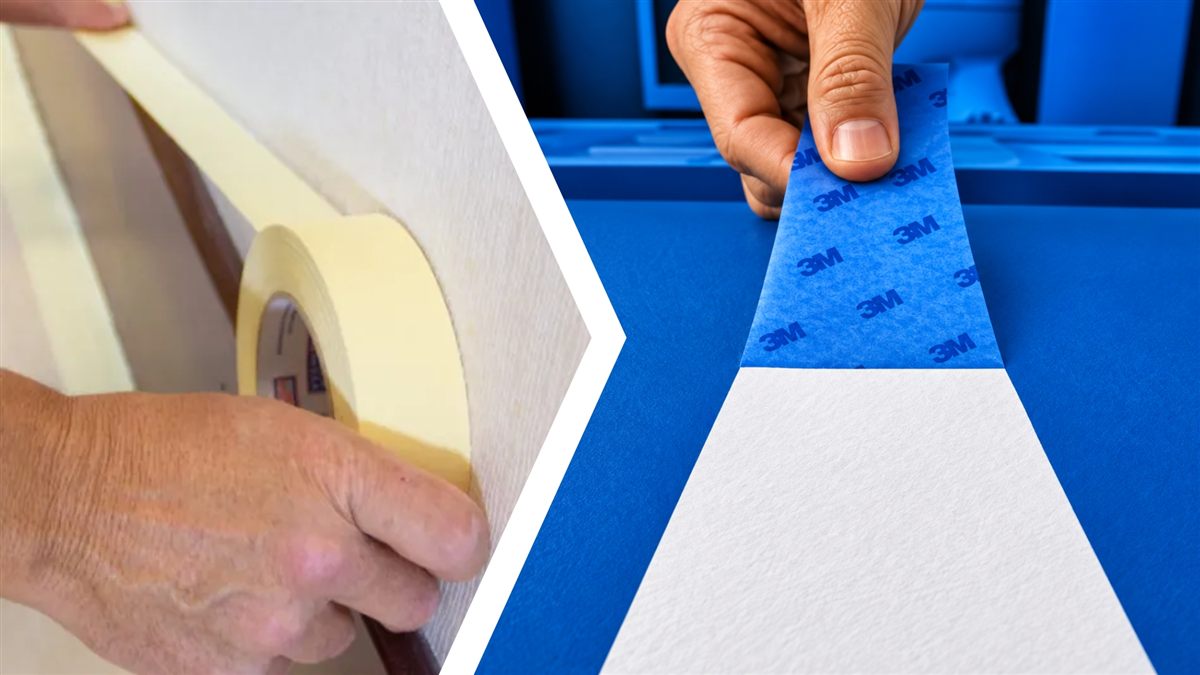
Painter’s tape and masking tape look alike, but they suit different jobs. Use painter’s tape when the tape needs to stay on for days, or when you need a sharp paint edge on a finished surface. Use masking tape for short-term masking, holding, bundling and labelling.
Painter’s tape vs masking tape: the main differences
Painter’s tape is a type of masking tape made for paint work. Both are paper tapes that tear by hand. The differences show up in how long the tape can stay on, how it handles sun and heat, and how clean an edge it leaves.
| Feature | Painter’s tape | Masking tape |
|---|---|---|
| Best for | Painting, staining and surface treatments that need sharp edges | Painting, surface protection and short-term masking |
| Adhesive | Medium or low tack | Low to medium tack |
| Time on the surface | Clean removal for up to 14 days or more, depending on the surface | Short-term jobs |
| Sun and heat | UV- and temperature-resistant grades | Depends on the grade. High-temperature grades are made for paint curing and powder coating. |
| Surfaces | Drywall, wood, metal and glass | Painted walls, trim, glass and metal |
Painter’s tape uses: longer jobs and sharp paint edges
Choose painter’s tape when the finish matters or the tape has to stay on for several days. Common uses include:
- Residential and commercial painting
- Masking trim, edges and delicate surfaces
- Industrial coating or powder-coating prep
- Sign and graphic masking
- Surface protection during transport
Compare our grades in the painter’s tape section of our specialty tapes.
Masking tape uses: short jobs, holding and labelling
Choose masking tape when the job is short and the tape comes off soon after. Common uses include:
- Short-term masking during painting and finishing
- Holding and bundling parts during assembly
- Covering parts during manufacturing
- Labelling and colour coding in warehouses
Masking tape also comes in specialty grades, such as high-temperature tapes for paint curing and powder coating. Our article on the industrial uses of masking tape covers these in more detail. For the full range, see our masking and general-purpose tapes.
Masking tape for painting: when it works
Masking tape works for paint jobs that finish quickly. Remove it as soon as the job allows. If the tape will stay on for days, use a painter’s tape whose clean-removal time covers the job. If it will face sun or heat, choose a UV- and temperature-resistant grade. If you aren’t sure of the surface, test the tape on a small, hidden area first.
Choosing painter’s or masking tape: questions to ask
- What surface is it going on? Check that the tape is listed for that surface, such as drywall, wood, metal or glass.
- How long will it stay on? For anything longer than a short job, choose a tape whose clean-removal time covers it.
- Will it face sun or heat? Look for a UV- and temperature-resistant grade.
- Will the paint edge show? Use a painter’s tape made for sharp edges.
Applying painter’s and masking tape: getting a sharp paint edge
- Apply the tape to a clean, dry surface.
- Press the edge down firmly along its full length.
- Remove it within the clean-removal time the maker lists.
- Peel slowly, pulling the tape back on itself at an angle.
Frequently asked questions
What’s stronger, painter’s tape or masking tape?
Neither is stronger as a rule, because strength depends on the grade. Our painter’s tapes come in medium or low tack, and our masking tapes in low to medium tack. For a firmer hold, our general-purpose tapes use a medium-tack rubber or acrylic adhesive.
What tape is best for painting walls?
Use painter’s tape for walls, especially when the tape stays on for more than a short job. Our painter’s tapes are listed as safe on drywall, wood, metal and glass.
How long can painter’s tape stay on?
It depends on the tape and the surface. Our painter’s tapes offer clean removal for up to 14 days or more, depending on the surface. Check the product’s clean-removal time before you start.
Does the colour of painter’s tape matter?
Colour alone doesn’t tell you the grade, because each maker uses its own colours for its own products. Choose by the surfaces and clean-removal time the maker lists.